

Saltford Parish Council (SPC) has now submitted its formal response to the West of England Mayoral Combined Authority (WECA) consultation on the proposed Keynsham Section of the A4 Bath to Bristol Strategic Corridor project.
A full copy of SPC’s response is both summarised and reproduced below, and is also available in full at ‘Saltford Parish Council response – Section 7‘.
Please visit WECA’s ‘Have you say’ page for ‘A4 Bath to Bristol – Keynsham section consultation’ to view proposals, respond to the questionnaire, and for further information at https://haveyoursaywest.co.uk/keynsham/
Saltford Parish Council’s response was approved at its September meeting and submitted ahead of the consultation closing date of 22 September 2026. Residents were welcome to attend and address the Council on any matter to be resolved on the agenda.
Although the proposals are located principally within the area represented by Keynsham Town Council, Saltford Parish, SPC’s response focuses specifically on the wider implications of the proposals for Saltford residents, businesses and users of the A4 strategic corridor.
The A4 Bath to Bristol corridor is a strategic transport route used daily by many Saltford residents and businesses, and changes made elsewhere along the route can have direct implications for traffic flow, journey times, bus services, road safety, network resilience and air quality in Saltford.
SPC’s Overall Position
Saltford Parish Council supports investment in public transport, walking and cycling where clear and demonstrable benefits can be shown. However, SPC considers that WECA has not yet provided sufficient evidence, modelling or supporting information to justify several of the Keynsham proposals.
As a result, SPC has formally objected to four proposals within the consultation:
- Gaston Avenue access to the Keynsham Bypass
- Keynsham Bypass bus stops (access to X39 services)
- New and upgraded crossings at Hicks Gate Roundabout
- Reduced speed limit on the Keynsham Bypass
The Council’s objections are based on concerns regarding the lack of published evidence supporting these proposals and their potential impact on traffic flow, journey times, network resilience and the strategic function of the A4 corridor.
In contrast, SPC welcomes the principle of the proposed shared-use path alongside the Keynsham Bypass as a means of improving active travel connections between Bath and Bristol. However, the Council believes that insufficient information has been provided regarding its detailed design, operation, expected usage and overall benefits, and has therefore reserved its position pending further information.
In light of the concerns set out above regarding the questionnaire design, Saltford Parish Council submitted its comments through Section 7 (“Additional comments”) only and did not submit responses to the remaining sections of the questionnaire.
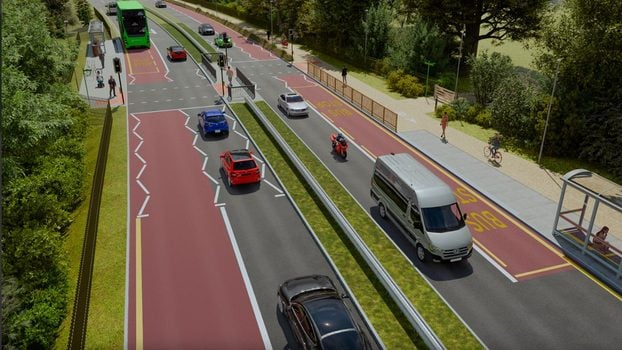
WECA image of proposed A4 Keynsham Bypass bus stops and bus lanes, taken from the Have Your Say A4 Bath to Bristol Keynsham Section page linked at the top of the article.
Summary of SPC’s Key Points
1. Greater clarity and evidence required
SPC is concerned that WECA has not published sufficient evidence to allow consultees to properly assess the proposals. While the consultation describes the infrastructure being proposed, it provides limited information on the specific problems being addressed, the benefits expected, or how success will be measured. The Council is therefore calling for traffic modelling, environmental assessments, business case information and clear performance measures to be published before decisions are made.
2. Corridor-wide impacts
SPC believes the A4 should be considered as a single strategic transport corridor rather than a series of separate schemes. The Council is concerned that changes in Keynsham could affect traffic conditions, journey times and bus reliability elsewhere on the route, including in Saltford. SPC has also questioned whether delays arising from additional crossings, signals and lower speed limits on the Keynsham Bypass could offset any benefits expected from the proposed bus lane between Broadmead Roundabout and Copse Road in Saltford.
3. Traffic flow, congestion and network resilience
SPC is concerned that the combination of bus lanes, new crossings, additional traffic signals and lower speed limits could reduce the capacity of the Keynsham Bypass and increase congestion. The Council has requested evidence that the proposals have been assessed against future traffic growth, as well as their impact on network resilience during incidents, roadworks and periods of high demand. SPC has also requested publication of any road safety, air quality and carbon emissions assessments.
4. Keynsham Bypass proposals
SPC has questioned whether the scale of intervention proposed on the bypass is justified and whether alternative approaches have been fully explored, including provision of bus services in Keynsham town. The Council has also asked how new bus stops, crossings and reduced speed limits align with the Keynsham Bypass’s role as a strategic route between Bath and Bristol, and whether they represent the most effective way of improving public transport accessibility.
5. Construction and bus service disruption
SPC has urged WECA to learn lessons from its (with CURO) recent A4 works between Saltford and Keynsham, which caused significant disruption to traffic, local businesses and bus services. The Council is seeking stronger commitments on traffic management during construction, including maintaining two-way traffic flow wherever reasonably practicable. SPC has also highlighted the impact of previous X39 diversions and is seeking assurances that future works will be planned with bus operators to minimise disruption to services.
6. Need to demonstrate genuine benefits
While supportive of investment in public transport, walking and cycling, SPC believes each proposal should be supported by clear evidence of the benefits it will deliver. The Council is seeking assurance that the measures will provide measurable improvements to journey times, reliability, safety or active travel, and represent good value for public money.
7. Shared-use path
SPC welcomes the principle of a shared-use path alongside the Keynsham Bypass as a means of improving active travel links between Bath and Bristol. However, the Council believes more information is needed regarding its design, operation, anticipated usage, whether cycling on the bypass itself would still be permitted, and overall benefits before it can be properly assessed. SPC has therefore reserved its position pending further details.
8. Consultation questionnaire
SPC has raised concerns about the design of the consultation questionnaire, noting that respondents can express varying degrees of support but are not given an equivalent option to clearly register opposition. The Council questions whether this approach can accurately capture the full range and strength of public opinion (to be reflected in any subsequent WECA report) and is considering whether these concerns warrant a formal complaint to WECA.
9. Conclusion
SPC supports investment in public transport, walking and cycling where clear benefits can be demonstrated. However, based on the information currently available, the Council considers that insufficient evidence has been provided to justify several of the proposals or to assess their wider impacts on the A4 corridor (including in Saltford). SPC has therefore objected to four proposals within the Keynsham Section, whilst welcoming the shared-use path in principle and calling on WECA to publish the full evidence base before any final decisions are made.
SPC’s full response to the Keynsham Section consultation
Saltford Parish Council’s full response to section 7 (additional comments) of the questionnaire contains more detail on the points above.
Please find below SPC’s full consultation response as submitted to WECA, cc. the MP for Northeast Somerset and Hanham, and both Saltford B&NES Council Ward Councillors, as submitted to WECA on 10 September.
A copy can also be downloaded at ‘Saltford Parish Council Response – Section 7‘
1. Need for Greater Clarity and Evidence
Saltford Parish Council (SPC) welcomes the opportunity to comment on the Keynsham Section proposals of WECA’s A4 Bath to Bristol project. SPC recognises that the proposals are located principally within the area represented by Keynsham Town Council. However, the A4 Bath to Bristol corridor is a strategic transport route used daily by many Saltford residents and businesses. SPC’s comments therefore focus on the implications of the proposals for users of the wider corridor, including potential impacts on traffic flow, journey times, bus services, network resilience and the cumulative effects of proposals across adjacent sections of the A4 as well as on the A4 in Saltford.
As with SPC’s response to the Saltford section consultation (WECA ‘Bath to Bristol’ consultation October–December 2025 – SPC’s November 2025 response at https://www.saltfordparishcouncil.gov.uk/wp-content/uploads/2025/11/Saltford-Parish-Council-A4-Bath-to-Bristol-Consultation-4-Nov-2025.pdf ), with regards to the current ‘Keynsham Section’, the Parish Council remains concerned by WECA’s lack of clarity regarding the specific objectives and expected outcomes of the individual proposals.
WECA states in the Keynsham Section consultation that the project aims to ‘give people better choices to travel sustainably, improving the route for buses etc’. However, this broad statement does not provide sufficient information for residents or organisations to assess whether the proposed interventions are justified or likely to achieve their intended outcomes. For meaningful consultation to take place, WECA should clearly explain the purpose of each proposal in terms of ‘improving the route for buses’ to include the measurable benefits it is expected to deliver, such as improved bus journey times, enhanced reliability, increased passenger numbers, improved safety, reduced congestion or environmental improvements.
Given WECA’s statement that this is the final full consultation on the Keynsham proposals, SPC is disappointed that consultees are again being asked to comment without access to the evidence, modelling and assessment work necessary to properly evaluate the proposals. SPC notes that this concern was also raised in its response to WECA’s October–December 2025 consultation and remains unresolved, despite WECA having stated to SPC that it holds such modelling information prior to consultation. SPC has consistently highlighted concerns regarding the lack of detail provided in consultations on the A4 corridor and the difficulty this creates for informed engagement. SPC is disappointed that consultees continue to be asked for views on significant transport interventions without access to the full supporting evidence, modelling, environmental assessments and appraisal work. SPC remains concerned that the consultation materials focus heavily on describing the infrastructure proposed, but provide very limited information regarding the specific transport outcomes the infrastructure is expected to achieve, the extent of those benefits, and the evidence supporting them.
SPC therefore requests that, prior to any decision being made, WECA publishes the traffic modelling and business case evidence supporting the scheme, including assessments of the impact of:
- The proposed 200m bus lanes on the A4 Keynsham Bypass;
- The proposed reduction in speed limits on the A4 Keynsham Bypass and Hicks Gate Roundabout;
- The introduction of new bus stops on the A4 Keynsham Bypass;
- The proposed signal-controlled pedestrian crossing on the A4 Keynsham Bypass; and
- The cumulative effect of these measures on traffic flow, bus journey times and bus reliability in both directions along the A4 corridor.
SPC also requests that WECA publish the specific success measures against which the scheme will be assessed. These should include anticipated changes to bus journey times, bus reliability, passenger numbers, traffic flow, journey times for general traffic, road safety outcomes, active travel usage, air quality and carbon emissions. Without clearly defined and measurable objectives, it is difficult for consultees to assess whether the proposals are likely to deliver meaningful benefits or whether they should be considered successful following implementation. Should the scheme be implemented, the publication of such measures would also assist in assessing its long-term effectiveness and whether the anticipated benefits have been realised when the scheme is subsequently reviewed.
SPC further requests publication of the scheme’s economic appraisal and Benefit-Cost Ratio (BCR), together with the assumptions used in the calculation of anticipated benefits. This information is necessary to understand whether the expected benefits justify both the financial investment and the wider impacts of the proposals on residents, businesses and highway users. Given the scale of public expenditure involved, transparency regarding value for money is essential.
In addition, SPC requests that WECA publish details of alternative options considered during development of the scheme. This should include a “do minimum” option, alternative approaches to improving bus reliability without significant highway alterations, and any options discounted during the design process. Consultees should be able to understand not only why the preferred option has been selected only for public consultation by WECA but also why other potentially less disruptive alternatives have been rejected.
In particular, SPC requests clarification on the following points:
- What are the specific objectives of the proposed bus lanes on the A4 Keynsham Bypass, and what evidence demonstrates that they are required?
- What existing transport problems are these measures intended to address at this location?
- What quantified benefits are expected in terms of bus journey times, reliability and passenger numbers?
- How have the impacts of additional signal-controlled crossings, speed reductions and lane changes been incorporated into the modelling and expected outcomes?
- How do the Keynsham proposals contribute to the overall objectives of the A4 Bath to Bristol project, and how do they interact with proposals being consulted upon elsewhere on the route, including in Saltford?
2. Strategic Context and Cumulative Impacts
Saltford Parish Council is particularly concerned that the Keynsham proposals appear inconsistent with proposals previously consulted upon in Saltford. For example, although WECA has not clearly stated the purpose of the proposed bus lane between Broadmead Roundabout and Copse Road (Saltford), it is reasonable to assume that it is intended to improve bus journey times and reliability. However, any benefits achieved through such measures could be offset by the proposals, including lower speed limits, additional traffic signals, new crossings and bus stop infrastructure on the A4 Keynsham Bypass. The introduction of signal-controlled crossings and reduced-speed sections on the A4 at this location is likely to increase journey times for all road users, including buses.
This raises wider questions about the coherence of the overall A4 Bath to Bristol programme. SPC considers it essential that WECA demonstrates how the individual schemes fit together and provides evidence that the cumulative effect of the proposals will deliver the stated project objectives rather than undermine them.
SPC notes that WECA has previously referred to traffic modelling, air quality analysis and carbon emission assessments having been undertaken in relation to proposals on the A4 corridor. As the A4 is a continuous strategic route, any increase in congestion or delays arising from the Keynsham proposals could directly affect conditions in Saltford, including traffic flow, journey times and local air quality. This is of particular concern to residents living or partaking in ‘active travel’ along the A4 Bath Road and to the many Saltford residents who rely on the route for access to employment, education, healthcare and other services. The Parish Council is therefore disappointed that this information has not been made available as part of the current consultation and reiterates its request that the supporting evidence base be published before decisions are taken.
Saltford Parish Council also questions the rationale for WECA consulting on adjacent sections of the A4 separately. Transport impacts do not stop at WECA-set boundaries, and proposals in Keynsham cannot be considered in isolation from those in Saltford and elsewhere along the A4. Though likely more convenient for WECA, this piecemeal consultation process makes it difficult for consultees to understand the cumulative impacts of the overall A4 Bath to Bristol scheme and limits their ability to provide informed feedback. SPC views that, as previously by WECA, the Keynsham Section should have been included as part of the consultation on sections of the A4 either side of the Keynsham Section (as included in the Oct-Dec 2025 consultation).
The Parish Council is concerned that the cumulative effect of proposals currently being advanced for both Saltford and as proposed for Keynsham could result in longer journey times and reduced network resilience. The addition of further traffic signals, bus lane transitions and lower speed limits may introduce additional delay and uncertainty for all road users, including bus passengers.
3. Traffic Flow, Congestion and Network Resilience
Saltford Parish Council is also concerned about the potential impact on traffic flow. The proposed introduction of bus lanes on sections of the A4 Keynsham Bypass, combined with signal-controlled crossings and reduced speed limits, would effectively reduce the capacity of this important route. There is a significant risk that these measures could create bottlenecks, increase congestion and lead to delays extending beyond Keynsham, including on the A4 through Saltford (the main route for Saltford residents to access the village).
Saltford Parish Council reiterates concerns previously raised regarding future housing and employment growth within Bath and North East Somerset and neighbouring authorities. SPC has consistently highlighted the impact that future development could have on the A4 corridor and the importance of considering future as well as current demand. The A4 corridor already experiences significant congestion and disruption during peak periods and incidents. SPC therefore requests evidence that the proposed measures on the A4 Keynsham Bypass have been assessed against future traffic growth scenarios and will remain effective under forecast demand levels rather than current traffic conditions alone.
Saltford Parish Council is additionally concerned that reducing the operational flexibility of the A4 Keynsham Bypass through additional signal-controlled infrastructure, lower speed limits and lane constraints may reduce the resilience of the network during incidents, roadworks and periods of unusually high demand. The Parish Council requests evidence demonstrating how the proposals would affect network performance under such circumstances.
SPC also requests publication of any assessments undertaken regarding air quality, carbon emissions and wider environmental impacts. While the scheme is presented as supporting sustainable transport objectives, SPC notes that lower speed limits, increased signal-controlled stopping points and potential increases in congestion may have unintended consequences for vehicle emissions. Consultees should therefore be provided with evidence demonstrating that the proposals will deliver an overall environmental benefit.
The Parish Council is further concerned about potential road safety implications. The introduction of new traffic signals, lane changes and merging movements on a route that currently operates as a free-flowing dual carriageway may increase conflict points and the potential for collisions. SPC therefore requests that WECA publishes any road safety assessments undertaken in support of the scheme.
4. The A4 Keynsham Bypass Proposals
Saltford Parish Council requests details of the engagement undertaken with bus operators regarding both the design of the scheme, future services and the management of construction impacts. The Parish Council questions whether the level of intervention proposed on the A4 Keynsham Bypass is justified by the relatively limited number of bus services that would use the infrastructure. It also questions the likely level of demand for bus stops on the A4 Keynsham Bypass, particularly given the availability of existing bus services through Keynsham town, potential for further bus services servicing existing stops in Keynsham town, and Keynsham Railway Station.
SPC also reiterates its previously stated position that bus stop infrastructure should be designed to minimise impacts on traffic flow and road safety. SPC has previously supported – and continues to support – the principle that bus stops should be positioned to minimise disruption to traffic flow and that bus lay-bys should be used wherever feasible. The Parish Council therefore requests clarification on whether bus lay-bys have been considered by WECA as part of the A4 Keynsham Bypass proposals and, if so, why they have been discounted.
SPC believes a more fundamental question should also be addressed. The primary purpose of the A4 Keynsham Bypass has historically been to provide an efficient strategic route between Bath and Bristol and to reduce traffic pressures within Keynsham town itself. SPC therefore asks WECA to demonstrate how the introduction of bus stops, signal-controlled crossings, lower speed limits and associated infrastructure aligns with the strategic function of the A4 Keynsham Bypass and whether these proposals represent the most appropriate means of improving public transport accessibility.
Rather than introducing infrastructure that may adversely affect traffic flow on the A4 Keynsham Bypass, SPC asks whether alternative options have been explored with operators to improve bus connectivity to Keynsham town centre and surrounding communities.
5. Construction Impacts and Bus Service Disruption
Saltford Parish Council also seeks assurance that lessons have been learned from the recent A4 works associated with the Curo development and WECA’s CWIS (Connecting Walking and Infrastructure Scheme) as detailed in WECA’s West of England Local Cycling and Walking Infrastructure Plan 2020-2036 at https://www.westofengland-ca.gov.uk/wp-content/uploads/2022/04/Full-LCWIP-Jan-2021.pdf .
Those WECA works resulted in substantial traffic disruption during September 2025 to late July 2026, including significant impacts on local businesses and the diversion of bus services away from Saltford. SPC requests that WECA sets out how these experiences have informed the planning and delivery of construction for the current proposals.
In particular, SPC is concerned by WECA’s statement that it will ‘aim’ to maintain one lane of traffic in each direction during construction and will ‘try’ to coordinate with other roadworks. Given the scale of disruption experienced during recent A4 works, SPC believes stronger commitments are required. WECA should commit, wherever reasonably practicable, to maintaining traffic flow in both directions throughout any A4 construction and to coordinating works effectively to minimise disruption.
SPC further seeks assurance that construction impacts on bus services will be actively managed. The diversion of X39 bus services away from Saltford during recent A4 works had a significant negative impact on public transport users. With further major works proposed in Saltford and subsequently in Keynsham, there is a risk that prolonged disruption could discourage bus use and undermine wider sustainable transport objectives both immediately and on encouraging more bus use in the future. Effective mitigation measures should therefore be developed in partnership with bus operators.
6. Delivering Meaningful Transport Improvements
Saltford Parish Council is concerned that the current programme appears to place significant emphasis on delivering a large number of relatively modest interventions across the A4 corridor, without clearly demonstrating the extent of the benefits they will provide to residents, businesses and transport users. While SPC recognises the importance for WECA of securing future investment for regional transport improvements by demonstrating previous strategic transport ‘improvements’, it is important that WECA’s current schemes are justified on their own merits and supported by clear evidence of need and benefit.
The Parish Council would therefore encourage WECA to demonstrate how each individual proposal will deliver measurable improvements in practice, rather than relying on broad strategic objectives or the cumulative scale of the overall programme. Public confidence in the project will depend on transparent evidence that the proposed measures represent genuine transport improvements and are not being progressed primarily to support WECA’s future funding opportunities for government funding or wider strategic ambitions.
More broadly, SPC remains concerned that the consultation process continues to focus on individual interventions rather than presenting a clear corridor-wide strategy for the A4 between Bath and Bristol. The Parish Council strongly supports investment in public transport, walking and cycling where genuine benefits can be demonstrated. Its concerns relate not to the principle of investment, but to whether the specific proposals consulted upon represent the most effective means of achieving the stated objectives.
Major changes to a strategic transport corridor should be supported by transparent evidence, robust modelling, clear objectives and measurable outcomes. SPC therefore urges WECA to publish the full evidence base before final decisions are made for the Keynsham Section, enabling stakeholders to properly assess whether the proposals represent the most effective use of public resources and whether they will deliver the improvements claimed, and also for future assessment should the proposals be implemented.
7. Shared-Use Path
With regards to the proposed shared-use path adjacent to the A4 Keynsham Bypass, Saltford Parish Council welcomes the principle of improving safer active travel connectivity and options for this between Bristol and Bath. However, the consultation material does not provide sufficient detail on the design, layout, operation or construction of the facility to enable detailed comment. SPC would also welcome clarification on whether cyclists and other active travel users would continue to be permitted to use the existing highway. If this remains the case, it would be helpful to understand the evidence supporting the expected level of use of the new facility and how its benefits have been assessed against the cost and disruption of delivery. SPC therefore reserves its position pending the publication of further information.
8. Consultation questionnaire concerns
Saltford Parish Council has significant concerns regarding the design of the consultation questionnaire, particularly the response options provided within Section 4, ‘Your thoughts on the proposals’.
Respondents are offered only four choices: ‘Very positive change’, ‘Slightly positive change’, ‘No positive change’ and ‘No opinion’. Whilst two options allow varying degrees of support to be expressed, there is no equivalent option enabling respondents to indicate that they oppose a proposal or consider it would have a negative impact.
Consequently, respondents who object to a proposal but select ‘No positive change’ are effectively grouped together with those who may simply consider it would make little or no difference. Equally, respondents wishing to register a clear objection are not provided with a corresponding response option. Saltford Parish Council therefore questions whether WECA’s consultation questionnaire is capable of accurately measuring the level of support for, or opposition to, the proposals under consideration.
Given the strategic importance of the A4 corridor and the potential impact of these proposals, Saltford Parish Council considers that consultation arrangements should enable consultees to express the full range of views, including support, neutrality, concern and objection.
However, the response framework adopted within Section 4 of the questionnaire appears unnecessarily restrictive, providing respondents with opportunities to express support for proposals whilst providing no equivalent means by which opposition can be clearly recorded.
As a result, WECA’s questionnaire may not fully capture the range and strength of views held by affected residents and stakeholders, raising legitimate questions regarding the appropriateness, robustness and evidential value of WECA’s consultation methodology and the extent to which any resulting findings can be relied upon as an accurate measure of stakeholder opinion.
These concerns, together with others, will form the basis of a future Saltford Parish Council agenda item to determine whether the Council should submit a formal complaint to the West of England Mayoral Combined Authority regarding the design and conduct of the ‘A4 Bath to Bristol Strategic Corridor – Keynsham Section’ consultation questionnaire.
9. Conclusion
Saltford Parish Council remains supportive of investment in public transport, walking and cycling where clear and demonstrable benefits can be evidenced. However, based on the information currently provided, SPC considers that insufficient evidence has been presented to justify several of the proposed interventions within the Keynsham Section of the A4 Bath to Bristol project.
In particular, WECA has not provided sufficient information regarding the purpose of these measures, the transport problems they are intended to address, the benefits they are expected to deliver, or their likely impacts on traffic flow, journey times, network resilience, road safety and the wider operation of the A4 corridor.
Accordingly, in the absence of sufficient supporting evidence and pending publication of the information requested within this response, Saltford Parish Council OBJECTS to the following proposals:
- Gaston Avenue access to the Keynsham Bypass
- Keynsham Bypass bus stops (access to X39 services)
- New and upgraded crossings at Hicks Gate Roundabout
- Reduced speed limit on the Keynsham Bypass
SPC’s objections are based on the current lack of evidence for these proposals and the potential for adverse impacts on traffic flow, journey times, network resilience and the strategic function of the A4 corridor.
Regarding the proposed Keynsham Bypass shared-use path, SPC welcomes the principle of improved active travel provision between Bath and Bristol. It however considers that insufficient information has been provided on its design, operation, anticipated usage and benefits. SPC therefore reserves its position on this proposal pending publication of further details.
SPC also notes its significant concerns regarding the design and conduct of the consultation questionnaire, which does not provide respondents with any clear mechanism to register opposition to individual proposals. As a consequence, SPC questions the robustness and reliability of the consultation methodology and the extent to which any resulting findings can be relied upon as an accurate measure of stakeholder opinion. These concerns will be considered further by the Council, including whether a formal complaint should be submitted to WECA regarding the consultation process.
Finally, SPC reiterates its request that WECA publish the full evidence base, including traffic modelling, economic appraisal, environmental assessments and success measures, before any final decisions are taken on the Keynsham Section proposals. Publication of this information is essential to enable consultees to properly assess whether the proposals are justified, represent value for money and will deliver the broadly defined benefits claimed by WECA.
RESOLVED: 8 SEPTEMBER 2026